Wearable technology has already changed how people track their health. Smartwatches can monitor activity and other health metrics, and connected devices are becoming increasingly common.
Now, researchers are asking a new question: What if wearable technology could monitor the eye itself?
From smart contact lenses to connected eyewear, researchers are developing technologies that could eventually change how eye conditions are monitored, diagnosed, and treated.
The American Optometric Association highlighted this trend at Optometry’s Meeting 2026, identifying wearable technologies as a major area of future growth in optometry. The organization also pointed to a future where information from wearables, contact lenses, smartphones, and diagnostic tools could contribute to more personalized care.
Smart Contact Lenses
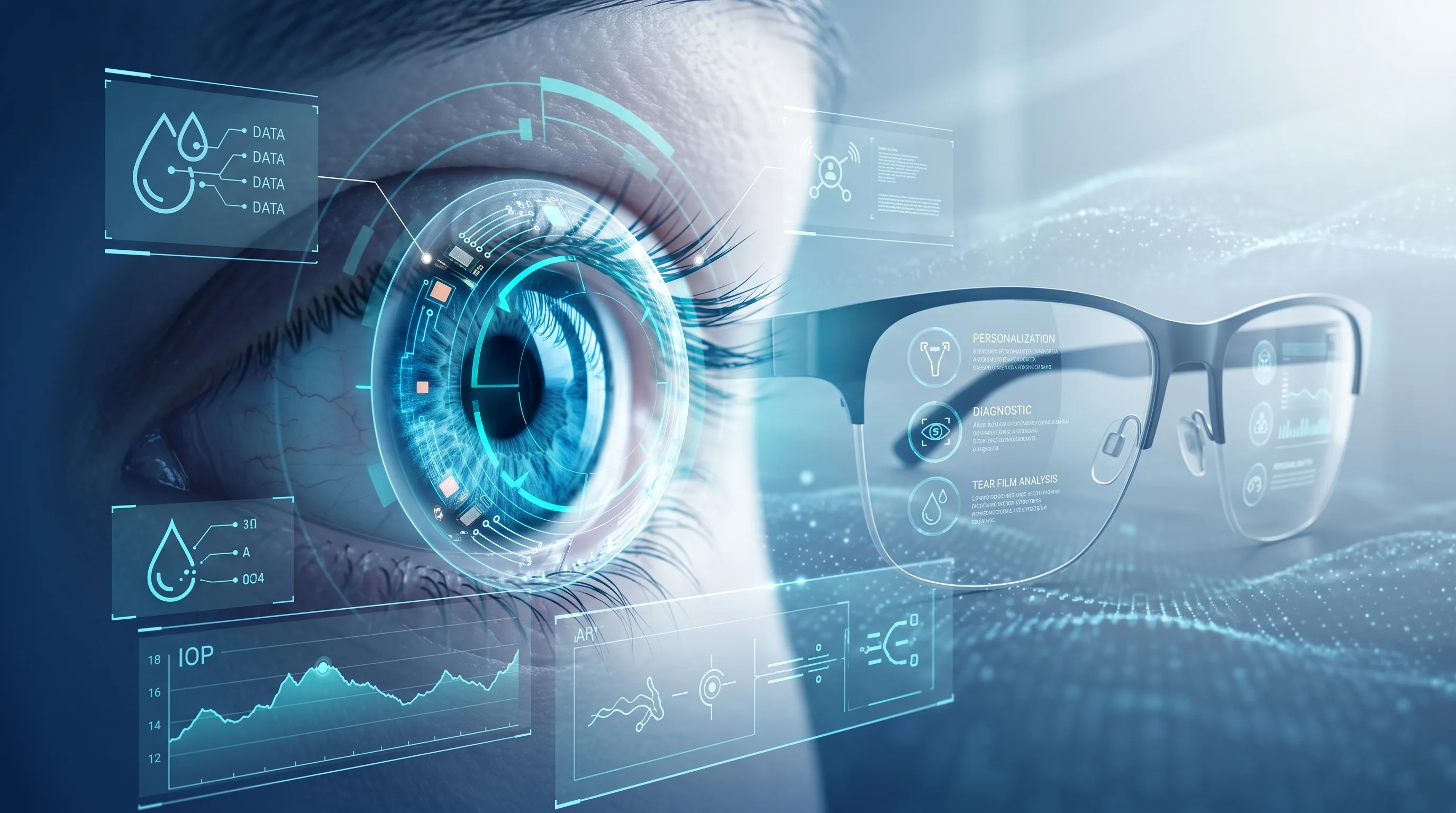
Smart contact lenses are one of the most interesting areas of wearable eye technology. Researchers are exploring ways to incorporate miniature sensors and electronic components into contact lenses so they can collect information from the eye and surrounding environment.
Potential applications include monitoring intraocular pressure, ocular inflammation, and certain biomarkers found in tears. Researchers are also investigating smart lenses for drug delivery and other therapeutic applications.
Glaucoma is one particularly interesting area. Because intraocular pressure can change throughout the day, researchers are investigating whether smart contact lenses could eventually provide more continuous information than the periodic measurements typically collected during an office visit.
These technologies are still developing, however. Smart contact lenses face challenges involving accuracy, comfort, power, wireless communication, and long-term safety before they can become routine clinical tools.
Your Tears May Tell Us More
One reason contact lenses are particularly interesting to researchers is their location: they sit directly on the eye and interact with tear fluid.
Tears contain biological information that researchers are studying for potential health applications. Smart contact lens sensors have been investigated for detecting chemical and physiological signals, including glucose and other biomarkers.
For example, researchers have developed experimental smart contact lenses capable of monitoring glucose levels in animal studies. While promising, this type of technology is not currently a standard method of diabetes monitoring in optometry practices.
That distinction is important. Many of the most exciting wearable technologies in eye care are still in the research and development stage.
Smart Glasses Could Expand What Wearables Can Do
Wearable eye technology isn’t limited to contact lenses.
Researchers are also exploring smart eyewear equipped with sensors, cameras, displays, and processing capabilities. These devices could have applications in teleophthalmology, remote assessment, and other areas of eye care.
Smart eyewear may also provide new possibilities for people with low vision by combining visual information with digital assistance.
As these technologies develop, eyewear could become more than something that helps a person see clearly. It could become another interface for accessing information and interacting with healthcare technology.
From Occasional Measurements to Continuous Data
Traditional eye care often provides a snapshot of a patient’s condition during an appointment. Wearable technology could eventually provide something different: information collected over time.
Researchers are exploring wearable devices that could periodically or continuously monitor certain physiological signals and transmit information wirelessly.
For conditions where measurements can fluctuate between appointments, that additional information could potentially give clinicians a more complete picture of a patient’s condition.
But more data isn’t automatically better.
The information needs to be accurate, clinically useful, secure, and presented in a way that helps providers make informed decisions.
The Technology Still Has a Long Way to Go
The potential is exciting, but wearable eye technology faces some significant hurdles.
A device worn directly on the eye needs to be comfortable and safe. Researchers are also working to improve sensor accuracy, power sources, wireless communication, durability, and biocompatibility.
There is also the question of what happens to all that data.
If wearable devices eventually collect health information throughout the day, practices will need reliable ways to receive, interpret, secure, and incorporate that information into patient care.
And before emerging technologies become routine clinical tools, they need appropriate validation and regulatory approval.
What Comes Next?
Wearable technology is unlikely to replace the traditional eye exam.
Instead, it could eventually add another layer of information to the care process.
Imagine combining:
- Traditional eye examinations
- Advanced diagnostic imaging
- Data from connected devices
- Wearable technology
- Remote monitoring
- Patient history
- Clinical expertise
The goal isn’t simply to collect more information.
It’s to have better information when it matters.
Smart contact lenses and connected eyewear are still developing, but research is moving quickly. A 2026 review of smart contact lenses describes their potential applications in diagnosis, disease monitoring, and treatment while emphasizing the challenges that still need to be addressed.
For optometry practices, the future may not be about adopting every new wearable technology that becomes available.
It will be about identifying which technologies provide meaningful information that can improve patient care.
The future of optometry may not just be about seeing more clearly.
It may be about understanding more.
Sources
- American Optometric Association — Highlights from Optometry’s Meeting 2026
- PubMed — Smart Contact Lenses: Disease Monitoring and Treatment (2025)
- PubMed — Smart Contact Lenses for Healthcare Monitoring and Therapy (2024)
- PubMed — Smart Contact Lenses as Wearable Ophthalmic Devices for Disease Monitoring and Health Management (2023)
- PubMed — Artificial Intelligence Enabled Smart Digital Eye Wearables (2023)
- PubMed — Enhancing Glaucoma Care With Smart Contact Lenses (2025)
- PubMed — Long-Term Stable Wireless Smart Contact Lens for Digital Diabetes Diagnosis (2023)
- PubMed — Smart Contact Lenses: Recent Advances and Future Challenges in Eye Disease Diagnosis and Treatment (2026)