
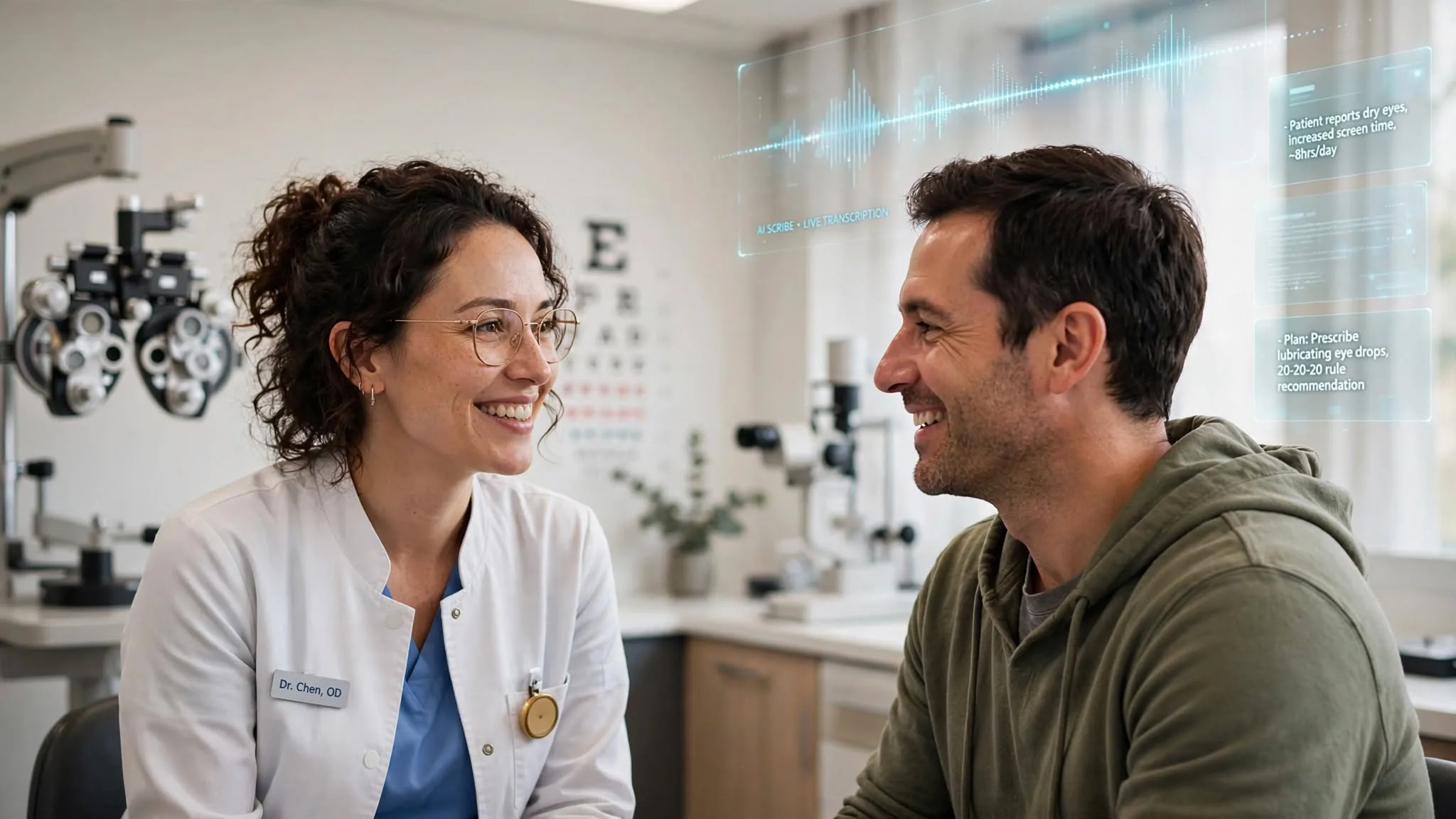
For many healthcare providers, documentation is an unavoidable part of the workday. After a patient leaves the exam room, there may still be notes to complete, charts to update, and other administrative tasks to finish.
AI-powered scribes are emerging as one potential way to reduce that burden.
But can they actually give optometrists more time with patients?
What Is an AI Scribe?
An AI scribe uses artificial intelligence to listen to a patient-provider conversation and generate a draft clinical note. Instead of documenting every detail manually during or after an appointment, the provider reviews and edits the AI-generated note before adding it to the medical record.
The technology is designed to assist with documentation, not replace the clinician.
The American Optometric Association has identified AI scribes as one of several emerging applications of AI that could support optometry practices, while emphasizing that AI should augment rather than replace healthcare professionals.
Could AI Reduce Documentation Time?
Early research suggests that AI scribes can help, although results vary between technologies and clinical settings.
A 2025 randomized clinical trial involving 238 outpatient physicians across 14 specialties compared two ambient AI scribe systems with usual care. One of the AI systems produced a statistically significant reduction in time spent writing notes, while the other did not show a significant difference. The study also found improvements in some measures of physician well-being.
A separate 2026 randomized crossover trial involving 160 outpatient clinicians found that both AI scribe systems studied improved workflow satisfaction and reduced some measures of burnout, although the amount of documentation time saved differed between the systems.
These studies weren’t conducted specifically in optometry, so their results shouldn’t be assumed to apply directly to every eye care practice.
Still, they suggest that reducing documentation workload is a realistic potential benefit of the technology.
More Time for the Patient
The potential benefit isn’t just about saving minutes.
If less of an appointment requires the provider to focus on documentation, there may be more opportunity to focus on the patient.
That could mean:
- More direct conversation with patients
- Less time spent completing notes after hours
- Less administrative workload
- More attention on the clinical interaction
However, whether an AI scribe actually produces these benefits depends on how accurately it works and how well it fits into the practice’s existing workflow.
AI Doesn’t Mean “Hands-Off”
One of the most important limitations is accuracy.
AI-generated documentation can contain errors. In a 2026 prospective study of more than 7,500 clinic notes, physicians evaluating a sample of AI-generated notes identified accidental omissions in 18%, hallucinations in 11.5%, and accidental inclusions in 9.3% of the notes evaluated. Most errors were considered mild to moderate, but some were rated as potentially serious.
That makes human review essential.
An AI scribe can create a starting point, but the provider remains responsible for reviewing the information and ensuring the final record is accurate.
Privacy Matters, Too
AI scribes may process conversations that contain protected health information, so privacy and security should be part of any practice’s evaluation process.
If a technology vendor needs access to protected health information to provide its service, HHS generally considers the vendor a business associate under HIPAA, which requires appropriate contractual and privacy safeguards.
Before adopting an AI scribe, practices should understand:
- How patient conversations are recorded and processed
- Where information is stored
- How long information is retained
- Whether the vendor uses a business associate agreement when required
- What security measures are in place
- How patients are informed about the technology
So, Can AI Give Optometrists More Time With Patients?
It may.
The research so far suggests that ambient AI scribes have the potential to reduce documentation burden and improve aspects of clinical workflow. But the results aren’t identical across every technology, and research specifically in optometry is still limited.
For optometry practices, the goal shouldn’t be to automate documentation simply because the technology exists.
Instead, it’s worth asking:
Can this technology reduce administrative work while maintaining accurate records, protecting patient information, and allowing the doctor to stay focused on the patient?
If the answer is yes, AI scribes could become a valuable tool in modern optometry practice.
The goal isn’t to replace the human side of eye care.
It’s to give optometrists more time to focus on it.
Sources
- American Optometric Association — Highlights from Optometry’s Meeting 2026
- PubMed — Ambient AI Scribes in Clinical Practice: A Randomized Trial
- PubMed — Comparing Ambient Scribes: A Randomized Crossover Clinical Trial
- PubMed — Quality of Clinical Notes Created by Ambient Listening Generative AI
- HHS — Business Associates
- HHS — Is a Software Vendor a Business Associate of a Covered Entity?